8 min read
Binaural Beats for Memory: Do They Work, or Is It Placebo?
What the research on binaural beats and 40 Hz gamma stimulation actually shows, why most YouTube tracks get it wrong, and how to test it on yourself in two weeks.
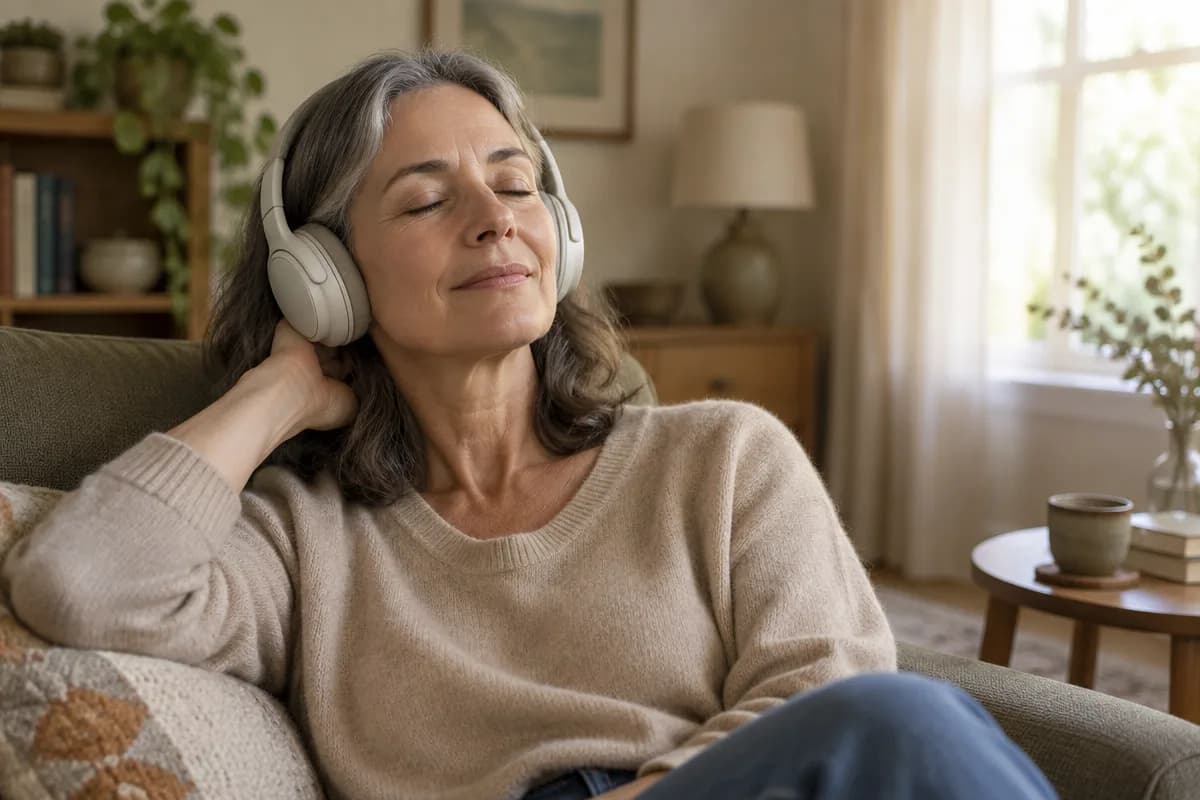
Search “binaural beats” on YouTube and you get ten-hour videos promising deeper focus, better memory, even higher IQ. Search Reddit and you get something more useful: people who have actually tried them. Their verdict is remarkably consistent. Most say some version of “it's probably placebo, but I sit down and get the boring task done, so I keep using it.”
That is a more interesting answer than either the sellers or the sceptics give, and it is worth unpacking. This article covers what binaural beats are, what the research on memory really shows, why the 40 Hz “gamma” tracks everyone links to are often built wrong, and a simple way to test whether they do anything for you.
What a binaural beat actually is
Play a 200 Hz tone in your left ear and a 240 Hz tone in your right ear, through headphones, and your brain perceives a third, pulsing tone at 40 Hz that does not exist in either ear. That perceived pulse is the binaural beat. The theory, called brainwave entrainment, is that the brain's own electrical rhythms drift toward the frequency of the beat. Gamma rhythms (roughly 30 to 100 Hz) are associated with attention and working memory, so a 40 Hz beat is marketed as a memory and focus aid. Theta and delta beats are sold for sleep and meditation.
Two things follow from this. First, binaural beats only work with headphones; through speakers the tones mix in the air and there is no beat. Second, the beat is a perception, not a sound, which is why the effect on the brain is subtle and why it is so hard to separate from expectation.
What the research says about memory
The most cited overview is a 2019 meta-analysis in the journal Psychological Research that pooled 22 studies. It found that binaural beats had a small but statistically significant effect on memory, attention and anxiety. Small is the key word. The effect sizes are in the range where a good night's sleep or a 20-minute walk would beat them comfortably. The authors also noted that longer exposure worked better than short bursts, and that the studies were mostly small and short.
Individual studies are mixed. Some show improved word recall or working-memory scores after listening to beta or gamma beats; others show no change, and at least one found that theta beats slightly worsened performance on a task that needed alertness. If you read the literature honestly, the picture is: a real but modest effect for some people on some tasks, not a reliable memory upgrade.
I don't know the science behind it, but it makes me focus more than usual. If it's placebo, tell me why it works so well on a boring lab report.
The 40 Hz gamma research is a different thing
Much of the excitement around “40 Hz” comes from work at MIT, where researchers found that exposing mice to light flickering at 40 Hz, and later to sound clicking at 40 Hz, reduced amyloid plaques and improved memory in models of Alzheimer's disease. Early human trials of the same idea, using a device that delivers synchronised 40 Hz light and sound, have reported slower cognitive decline in small groups of patients. This is genuinely promising research and it is ongoing.
But note what that stimulation is: a sound that clicks or pulses at 40 Hz, delivered for an hour a day for months, in a clinical protocol. It is not a binaural beat, and it is not a 40 Hz tone. This is where a lot of YouTube tracks go wrong. A 40 Hz tone is a low hum near the bottom of human hearing. What the research uses is a higher carrier sound whose volume is modulated 40 times a second. If you download a random “40 Hz gamma” track, you may be getting a low drone that does nothing, a correctly modulated pulse, or a binaural beat, and the video title will not tell you which.
So when someone on Reddit says gamma waves changed their life, and someone else says they are pseudoscience, they may both be right about different recordings.
Why it can work anyway
Here is the part the sceptics tend to skip. Even if brainwave entrainment turns out to be weak, sitting down with headphones, a steady sound and no notifications is a focus ritual, and focus rituals work. The sound masks office noise. The act of pressing play tells your brain the session has started. A 12-minute track gives the session a natural end. None of that requires the beat to alter your neurons, and all of it improves the odds that you actually study or write for the next half hour.
For memory specifically, that matters more than it sounds. Most everyday forgetting is an attention problem in disguise: the name never went in properly because you were half listening. Anything that reliably narrows your attention while you learn something will improve recall later, whatever the mechanism.
How to test it on yourself in two weeks
Pick one task and one track. Use the same 10 to 15 minute audio each time and the same kind of work (reading, revising, writing). Changing both at once makes the result meaningless.
Alternate days. Track on odd days, silence or plain white noise on even days. White noise is the fair comparison because it also masks distractions.
Score yourself the same way every day. A one-line note is enough: how long you stayed on task before checking your phone, or how many pages you got through. A free online working-memory test works too if you want numbers.
Use real headphones. Earbuds are fine; a laptop speaker is not. Keep the volume low. Loud is not more effective and it is bad for your ears.
Look at the pattern after 14 days. If track days are clearly better, keep it. If they are the same as white-noise days, you have your answer and it cost you nothing.
A ready-made option if you do not want to build your own
If you would rather not sift through YouTube trying to work out which tracks are built correctly, there are commercial audio programs made for exactly this. The one we list on this site is The Brain Song.
The Brain Song
The Brain Song is a 12-minute digital audio track designed to guide the brain toward gamma-range activity, which its makers link to BDNF, the protein that supports learning and memory. It is meant to be played once a day with headphones, at home. It is a one-off purchase, there is nothing to reorder, and it comes with a money-back guarantee, so it fits the two-week self-test above: try it on alternate days, keep notes, and refund it if your notes say it did nothing. We earn a commission if you buy through our link.
See The Brain Song's presentationThe honest conclusion
In short
- Binaural beats have a small, real effect on memory and attention in pooled studies, not a large one.
- The 40 Hz Alzheimer's research is exciting but uses a different kind of sound, delivered for an hour a day for months.
- Many free “40 Hz” tracks are built wrong; a 40 Hz tone is not the same as a 40 Hz pulse.
- Even as a focus ritual, they can improve how well things go into memory in the first place.
- Test it against white noise for two weeks before deciding it works, or doesn't.
This article may contain affiliate links. If you buy through them we may earn a commission at no extra cost to you. Nothing here is medical advice; talk to your doctor before starting any supplement.