9 min read
Bacopa vs Lion's Mane for Memory: What Long-Term Users Actually Report
How long bacopa takes to work, why it helps long-term memory more than short-term, the motivation side effect nobody warns you about, what lion's mane does and does not do, and how to take either properly.
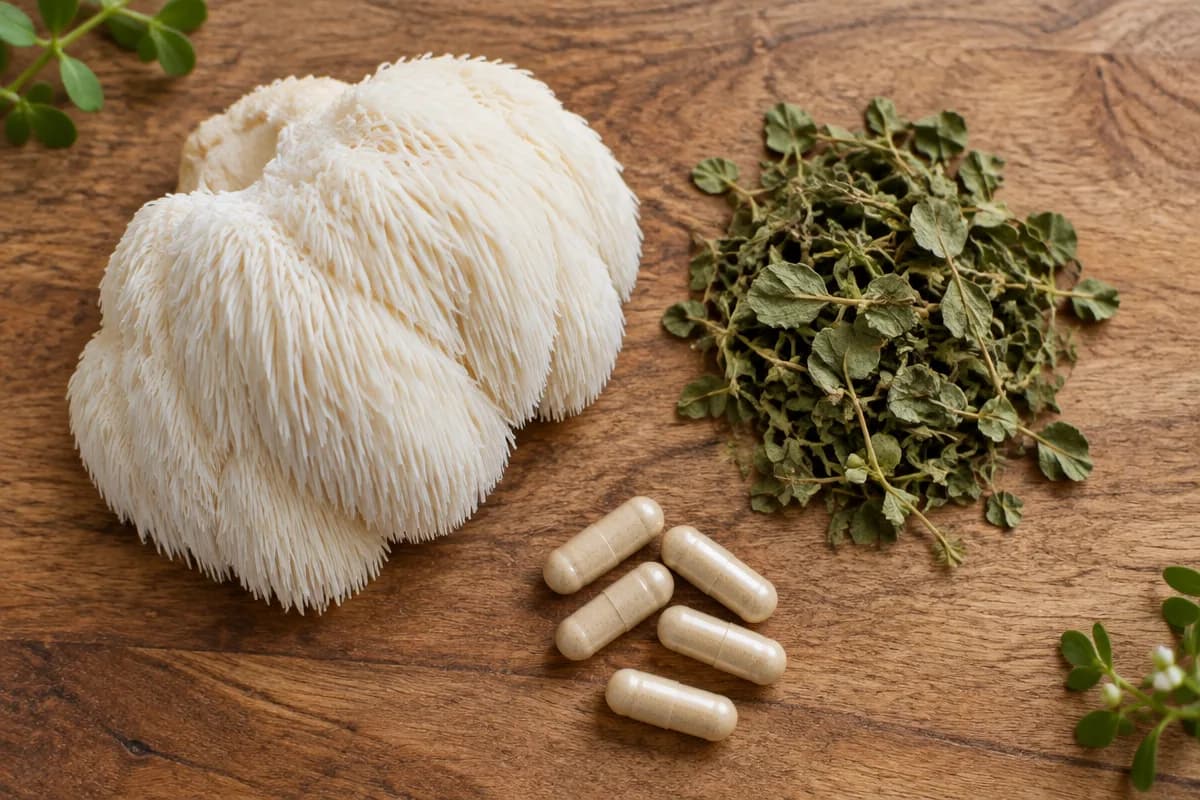
Open the label of almost any memory supplement and two names come up: Bacopa monnieri, a creeping wetland herb used in Ayurvedic medicine for centuries, and lion's mane, a shaggy white mushroom that grows on hardwood trees. Both are in the products we list on this site. Both have real studies behind them. And both have a long trail of Reddit threads where people describe, in detail, what happened when they took them for months.
Those threads are more useful than the studies for one question: what is it actually like? So we read them, six years' worth, alongside the research, to answer the questions people ask most: how long does it take, what does it do to memory, what are the side effects, and which one should you try first.
Bacopa: slow, steady, and mostly about long-term memory
Bacopa is the better studied of the two in humans. Several randomised trials, including one in healthy adults over 55, found improved memory acquisition and retention after 12 weeks of a standardised extract, with no effect at earlier checkpoints. That timeline matches the user reports almost exactly.
How long it takes: 4 to 12 weeks. The single most common answer in the “how long did it take” threads is one to two months, with a few people noticing something after a week and the studies saying twelve. One student went from spending all day revising before a test to reading his notes once, an hour before, and doing fine, after two months.
What it improves: consolidation, not working memory. Users repeatedly say short-term memory felt unchanged while long-term recall improved. Several describe a strange side effect at week three: vivid, random childhood memories surfacing unprompted. That is consistent with bacopa's proposed mechanism, which is on the formation and retention of memories rather than on holding things in mind right now.
It is calming, which cuts both ways. Bacopa reduces anxiety in trials and in user reports. For anxious people this is a bonus. For others it tips into the one side effect that matters: a flat, unmotivated feeling. One medical student stopped after seven weeks because although his memory was better, he “couldn't be bothered to test it.” Others took it for two to six years with no such problem. If you notice motivation dropping in the first two weeks, that is the signal to stop or halve the dose; it does not usually improve with time.
Take it with food. Bacopa is fat-soluble and hard on an empty stomach. Taking it after a meal fixes the nausea and cramping that put some people off, and improves absorption. Long-term users almost all take it after breakfast or dinner.
Dose. Studies use 300 mg a day of an extract standardised to 50 percent bacosides (sold as Synapsa or Bacognize), or 2 to 3 g of the whole dried herb. More is not better; the motivation effect is dose-related.
No need to cycle. A herbalist quoted at length in one thread noted bacopa's long history of continuous use and low toxicity. Users who stopped after months said the memory benefit faded slowly rather than crashing.
Six years on it. No side effects, and it's best after a meal. Memory benefits have been consistent; it's the main reason I've kept it in my stack.
Lion's mane: promising, mixed, and very quality-dependent
Lion's mane contains two families of compounds, hericenones and erinacines, that stimulate nerve growth factor in the lab. The best-known human trial gave 50 to 80-year-olds with mild cognitive impairment three grams a day for 16 weeks; their cognitive scores improved, then fell back after they stopped. Other small trials have found effects on mood. That is genuinely interesting, but the evidence is thinner and the studies smaller than for bacopa, and the user reports are correspondingly more scattered.
Responses split three ways. Roughly a third of the people in the experience threads report clearer thinking, more patience or better attention to detail, often within a month. A third report nothing beyond placebo. And a smaller group report negative effects: vivid dreams, low mood, or in one case at 4,200 mg a day, moments of panic. The high-dose panic reports are consistent enough to take seriously.
It is not a memory pill in the way bacopa is. The people who rate it highly describe mood and focus more than recall. A long-term bacopa user summed up the split: bacopa for memory, lion's mane for mood and “out of the box thinking.”
Quality is the whole game. Most cheap lion's mane is mycelium grown on grain, which contains little of the active compounds and a lot of starch. Fruiting-body extract, tested for beta-glucans and ideally for heavy metals, is what the trials used. Several disappointed users had been taking the bulk-powder kind.
Dose and timing. One to three grams a day of fruiting-body extract, with food, in the morning. Start at one gram. If you get vivid dreams, move it earlier in the day.
People with a real reason to be cautious. Lion's mane may affect blood clotting; anyone on blood thinners or with a bleeding-stroke history should ask a doctor first, as one r/stroke user did. It is an immunomodulator, so the same applies to autoimmune conditions like MS. Neurologists in those threads were sceptical but not alarmed: probably no harm, possibly no benefit.
I think it helps my fogginess rather than being placebo, because on my extra-foggy mornings I look back and realise I forgot to take it.
Which one first?
If your problem is retention, names that will not stick, material that will not stay learned, start with bacopa, give it twelve weeks with food, and watch your motivation in the first fortnight. If your problem is fog and flat mood more than recall, try a quality lion's mane extract for a month. Many long-term users end up on both, and most commercial memory formulas combine them for that reason, often with gotu kola or ginkgo, which users say make bacopa “more synergistic.”
The combined formulas we list
Two of the products on this site are built around exactly these two herbs plus supporting botanicals, which saves buying and dosing them separately. Both are plant-based, stimulant-free and come with a 365-day money-back guarantee, which is long enough to cover the twelve-week bacopa timeline with room to spare.
CogniSurge
CogniSurge combines bacopa monnieri and lion's mane with schisandra fruit, gotu kola and shilajit. Gotu kola is the traditional pairing with bacopa, and schisandra is an adaptogen users reach for when bacopa's calming effect goes too far, so the formula is a sensible answer to the motivation issue above. Multi-bottle bundles work out considerably cheaper per bottle. We earn a commission if you buy through our link.
See CogniSurge's presentationNeuroPrime
NeuroPrime shares the bacopa and lion's mane base and adds ginkgo biloba, pine bark extract, moringa, chlorella, spirulina, tamarind and neem. Ginkgo is the other classic bacopa partner, and the greens make this the option if you want a broader daily formula rather than a focused two-herb stack. Same plant-based, stimulant-free profile and the same 365-day guarantee. We earn a commission if you buy through our link.
See NeuroPrime's presentationIn short
- Bacopa: 4 to 12 weeks to work, improves long-term retention more than working memory, take with food, watch for flat motivation in the first two weeks.
- Lion's mane: mixed results, more about mood and fog than recall, fruiting-body extract only, start at 1 g, avoid high doses.
- Bacopa first for retention; lion's mane first for fog and mood; both together is the common long-term stack.
- Both need a doctor's okay with blood thinners, thyroid or psychiatric medicines, or autoimmune conditions.
- Judge bacopa at twelve weeks, not two.
This article may contain affiliate links. If you buy through them we may earn a commission at no extra cost to you. Nothing here is medical advice; talk to your doctor before starting any supplement.